Kyphoplasty Supplier Evaluation: KB-Series Evidence Ladder
Kyphoplasty supplier evaluation is the practice of testing every catalogue claim against a controlled document, a lot-linked record and a purchase-order commitment, in that order. Applied to the CHANGMEI KB-Series, the four evidence layers resolve into concrete items: published model data for KB0115, KB0120 and KB0210S1; certificate scope that names the balloon catheter, the tool kit and the inflator separately; a production chain that includes balloon forming and per-piece pressure testing; and stated terms for MOQ, lead time and pre-shipment acceptance.
Most evaluations stop at layer one. A buyer compares PSI, inflation volume and marker distance, requests a certificate PDF, and issues the order. That holds until a tender asks for a technical file, a customs broker asks for a free-sale certificate, or a backorder reveals that the manufacturer was buying finished balloon bodies.
What follows is a verification framework for the evaluation-to-execution transition: the model facts behind each KB-Series claim, the certificate covering each SKU group, the documents that carry sterilization and shelf life, and the acceptance terms to fix before the first carton ships.
What Capability Means in a Kyphoplasty Supplier Evaluation
Capability is the ability to reproduce a specified device to a documented standard, at a stated volume, with records that survive an audit. That definition produces three tests.
- Reproducibility. The device matches a controlled drawing revision, not a hand-built sample.
- Traceability. Tubing, folding, welding, sterilization and release are recorded by lot.
- Scalability. The same line can absorb your annual volume without changing process or subcontracting the critical component.
A trading company can survive a price negotiation and fail all three. It may supply a compliant device; it cannot show you the folding machine, the burst-test bench log or the sterilization lot record. The distinction matters more in kyphoplasty than in many device categories, because the attributes buyers care about — ≥400 PSI constrained burst pressure, uniform four-wing unfolding, accurate radiopaque marker spans, single-use EO sterilization with a three-year shelf life — are process outputs rather than design intentions.
The Four-Layer Evidence Ladder
Score each supplier claim at the highest layer where it can actually be demonstrated. A claim that cannot rise above layer one remains a marketing statement, however specific its number.
| Layer | What it contains | What it establishes | What it does not establish |
|---|---|---|---|
| 1. Published claim | Catalogue, web page, brochure | That a specification exists | Who makes the device, or to which revision |
| 2. Controlled document | Drawing revision, IFU, certificate scope line, technical file | That the specification is defined and, on a certificate, that the named product is in scope | That your lot was built to it |
| 3. Lot-linked record | Device history record, in-process and final test data, EO validation, release note | That your shipment was built and released to the controlled specification | That future lots will be identical |
| 4. Contractual commitment | PO terms, acceptance criteria, lead time, change-notification clause | That the obligation survives shipment | Regulatory approval in your market |
Two consequences follow. A certificate is a layer-two document: it proves scope, not shipment. And layer three is the layer buyers most often skip, yet it is the only one showing whether the attribute that mattered was actually measured on the units in the carton.
Why Documentation Now Decides Kyphoplasty Sourcing
Percutaneous balloon kyphoplasty (PKP) is a two-stage procedure: an inflatable bone tamp creates a cavity and partially restores vertebral height, and the cavity is then filled with bone cement. The balloon catheter is a small device with a disproportionate documentation burden.
Three pressures have moved evaluation from brochures to files. Regulation (EU) 2017/745 replaced the older MDD route, so an MDD-era certificate cannot support a Class IIa catheter file. Hospital tenders increasingly request technical documentation, UDI and IFU language versions at bid stage rather than after award. And movement of procedures into US ambulatory surgery centers adds buyers who need compact single-use configurations and predictable replenishment rather than large trays. Scale reinforces the point: North America held an estimated 42.5%–50.0% revenue share of the global kyphoplasty market in 2025, according to Grand View Research and Straits Research, which is one reason US clearance status now receives closer attention in distributor due diligence.
What the KB-Series Commits To, Model by Model
The KB-Series is a family rather than a single device, and specifications differ by model and shaft platform.
KB0115. Single-use and EO-sterilized, with a constrained burst pressure of ≥400 PSI and a maximum inflation volume of 6 cc. Overall length is 280 mm and channel ID is at least 3.10 mm. The balloon is medical-grade thermoplastic polyurethane (TPU) on a PU shaft, with radiopaque markers 15 mm apart and a stainless-steel stylet. Intended settings include orthopedic surgery, spine surgery, pain management and interventional pain clinics.
KB0120. An 8G catheter, 315 mm long, with a four-wing pleating TPU balloon; maximum inflation volume is 6 cc and constrained burst pressure is ≥400 PSI. The four-wing fold governs how evenly the balloon opens inside the cavity, which is why fold consistency is best verified on the production floor.
KB0210S1. An 11G model with a maximum inflation volume of 3 cc and a 10 mm radiopaque marker distance, intended for spine surgery, pain management and interventional pain clinics. The smaller volume and shorter marker span are access decisions, not quality grades.
KT-00-05 tool kit. A PKP instrument set in 06Cr19Ni10 stainless steel, covered through CE 0123, with TÜV SÜD Product Service GmbH named as notified body under the supplier's MDR quality-system certification. BI-20A-10 is the companion balloon inflator, certified separately as a Class I sterile device.
One caution for tender specifications: overall length and channel ID belong to the shaft platform, so they should be confirmed on the drawing for the exact ordering code rather than inferred from balloon volume or gauge. Where a tender fixes both values, request the model-specific drawing revision that carries them.
| Model | Verifiable specification points | Listed settings | Confirm on drawing or lot record |
|---|---|---|---|
| KB0115 | Single-use, EO sterilized; ≥400 PSI constrained burst; 6 cc maximum inflation; 280 mm overall length; channel ID ≥3.10 mm; TPU balloon on PU shaft; markers 15 mm apart; stainless-steel stylet | Orthopedic surgery, spine surgery, pain management, interventional pain clinics | Shaft platform and ordering code; burst and leak test data; EO lot and expiry |
| KB0120 | 8G; 315 mm length; four-wing pleating TPU balloon; 6 cc maximum inflation; ≥400 PSI constrained burst | Orthopedic surgery, spine surgery, pain management, interventional pain clinics | Pleat geometry and folding process record; length against your cannula set |
| KB0210S1 | 11G; 3 cc maximum inflation volume; 10 mm radiopaque marker distance | Spine surgery, pain management, interventional pain clinics | Marker span against balloon length; 11G access compatibility |
| KT-00-05 | 06Cr19Ni10 stainless steel; CE 0123 notified-body coverage under the MDR quality-system certificate | Percutaneous kyphoplasty instrument set | Material certificate, passivation record, kit composition list |
| BI-20A-10 | Balloon inflator; MDR Class I sterile certificate G21 088875 0011 Rev. 00; FDA establishment registration and device listing | Balloon inflation during PKP | Gauge calibration record; sterilization and packaging release |
Reading the Clearances SKU by SKU
The most common clearance error in supplier evaluation is treating one certificate as coverage for the whole system. At CHANGMEI the file splits across four documents and one national licence, each covering a different product group.
- US 510(k) K223709 — Kyphoplasty Balloon Catheter. Device Class II, Product Code HRX, assessed under 21 CFR 888.1100 for an orthopedic balloon used to create a cancellous bone void during PKP. Listed models include KB0210, KB0115, KB0115S1, KB0120, KB0120S1 and KB0210S1. The clearance rests on bench performance data with no clinical data claimed, so it supports safety and performance equivalence, not a clinical superiority argument.
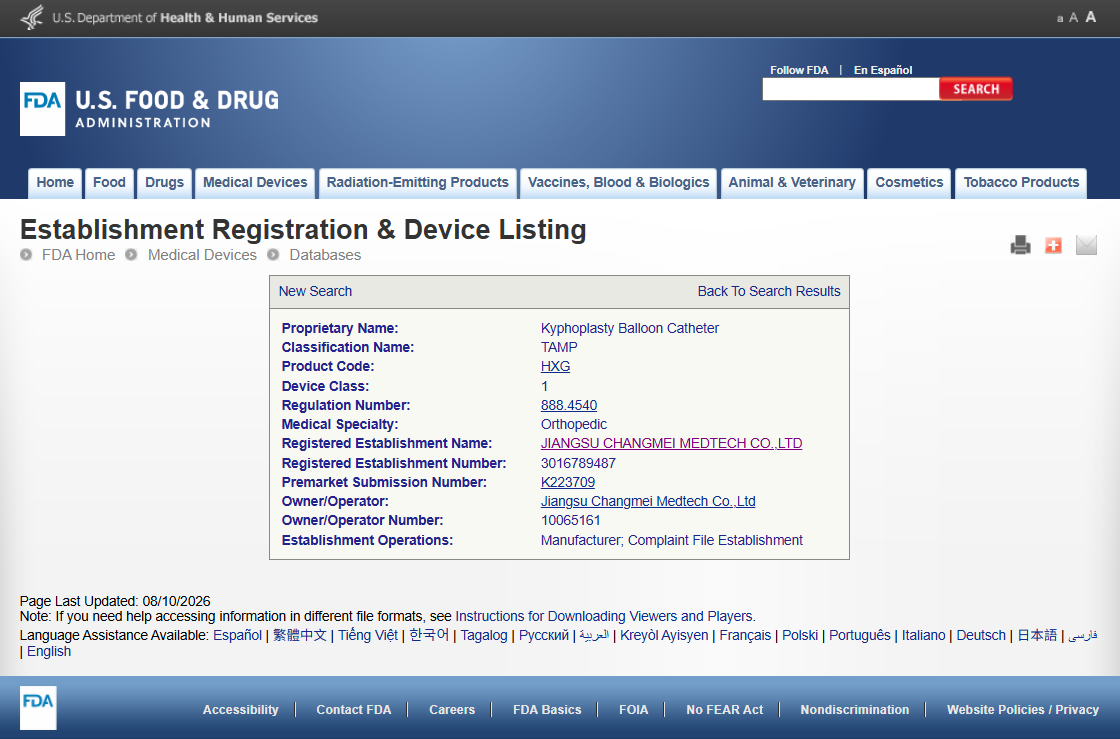
- FDA Establishment Registration and Device Listing 3016789487 — Balloon Inflator and Kyphoplasty Tool Kit. This is establishment registration with device listing, not a 510(k); read the listed products and the current expiry.
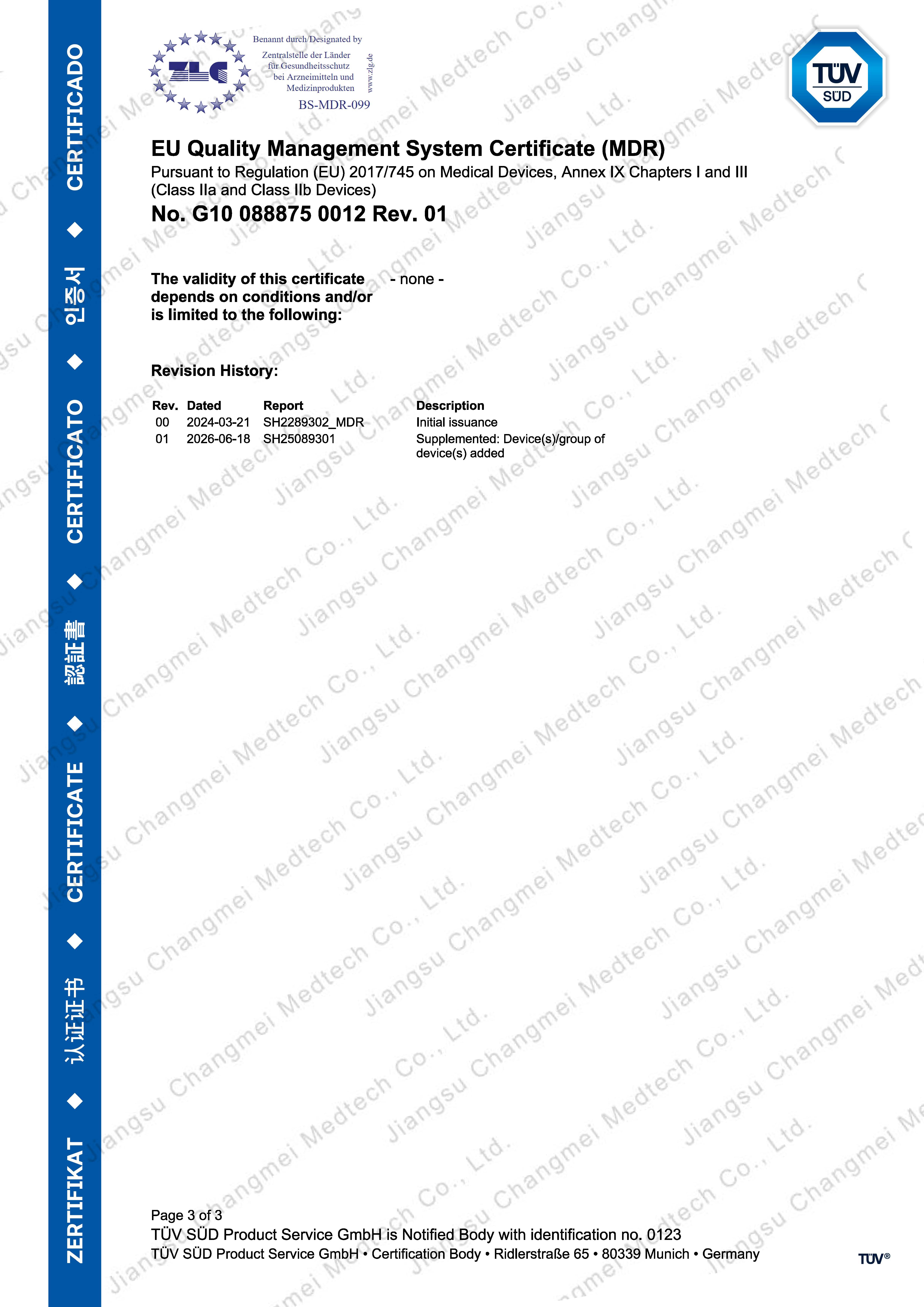
- EU MDR quality-system certificate G10 088875 0012 Rev. 01 — Class IIa and Class IIb. Issued by TÜV SÜD Product Service GmbH under Regulation (EU) 2017/745 Annex IX Chapters I and III, valid to 20 March 2029, covering the balloon catheter models and the KT-00-01 and KT-00-05 tool kits.
- EU MDR quality-assurance certificate G21 088875 0011 Rev. 00 — Class I sterile. Annex XI Part A, valid to 20 March 2029, covering the BI-20A-10 inflator.
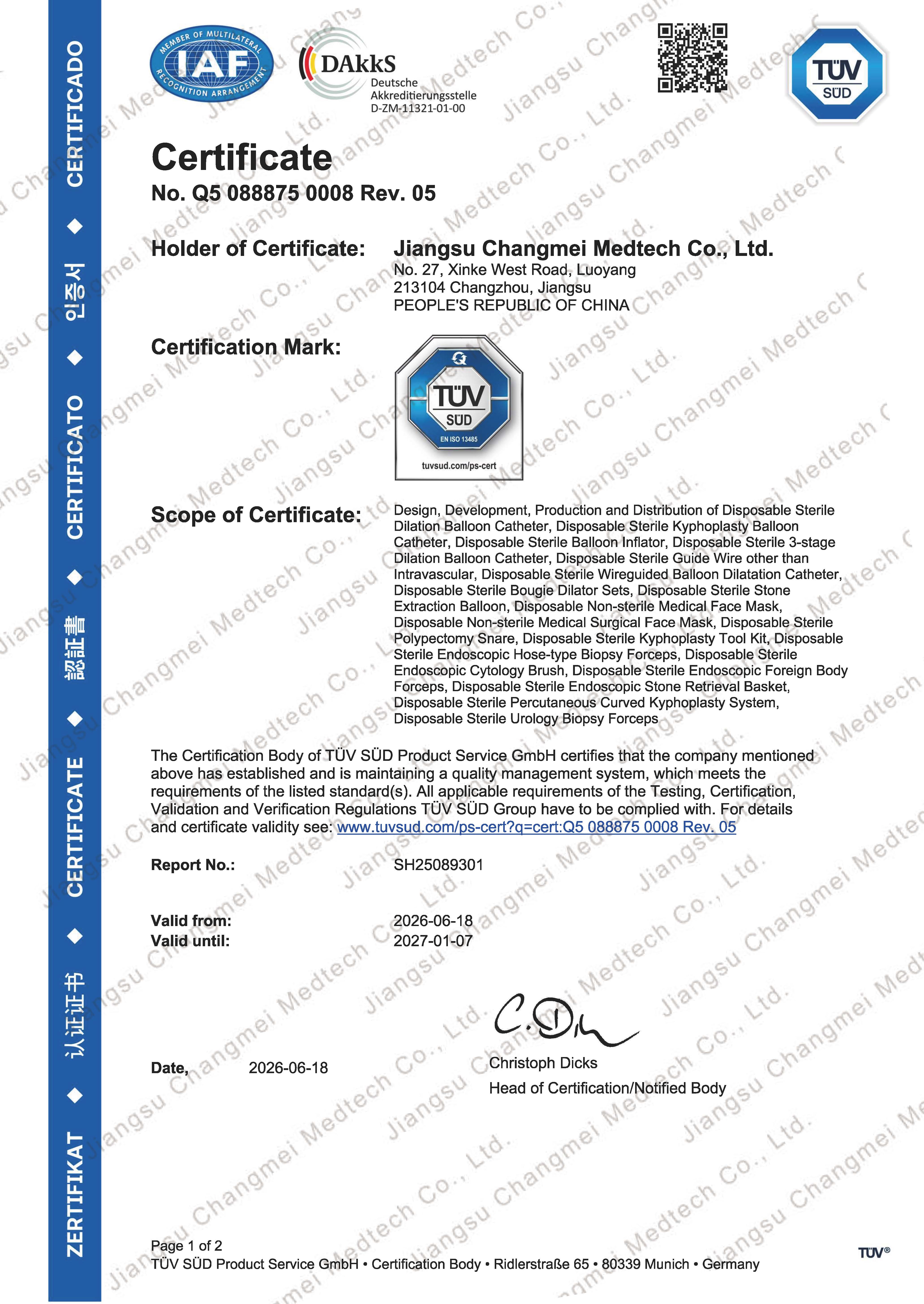
- EN ISO 13485:2016 certificate Q5 088875 0008 Rev. 05. Audited by TÜV SÜD for design, development, production and distribution of disposable sterile medical devices. The revision on file expires on 7 January 2027, so a buyer evaluating in late 2026 should place the renewal certificate on the release-for-shipment checklist.
- NMPA Class II and III registration and production licences for China, relevant where China is the reference market rather than the destination.
For every document, read three fields before filing: the scope line, the expiry date and the revision. A superseded revision is a finding, not a formality.
Sterilization, Shelf Life and Lot Traceability
The balloon catheter is single-use and sterile; reuse and re-sterilization are prohibited, sterilization is by ethylene oxide (EO), and shelf life is three years. The device should be used immediately after the package is opened, and clinical use follows the official instructions for use.
Six documents carry those statements:
- EO sterilization validation consistent with ISO 11135.
- EO residuals data, with ethylene chlorohydrin limits where applicable.
- Packaging validation covering seal integrity and simulated distribution.
- Shelf-life justification supporting the stated three years.
- Lot release record linking the shipment to sterilization and final test.
- Label artwork confirming UDI, expiry format and IFU language for the destination market.
Then add the receiving rule that prevents most disputes: record remaining shelf life at goods-in, not only the expiry date. Three years of shelf life delivered with eighteen months remaining is a different commercial position from one delivered with thirty-four.
Seven Verification Steps From Evaluation to Execution
- Fix intended use and market first. EU, US and Chinese routes need different evidence, so the certificate you need follows the destination, not the supplier's portfolio.
- Build a claim-to-document worksheet. Two columns: the claim, and the document that proves it. Claims with an empty second column stay open.
- Match certificate scope to SKU group. Catheter, tool kit and inflator are covered by different documents at CHANGMEI.
- Verify sterilization and shelf life against the six documents above.
- Verify manufacturing depth. Ask which steps are in-house — extrusion, balloon forming, necking, welding, four-wing folding, leak testing, cleanroom assembly — and which are subcontracted.
- Fix the commercial terms. MOQ, delivery term, payment, acceptance criteria and a change-notification clause.
- Set re-verification triggers. Certificate expiry, drawing revision, sterilization lot change and any change of manufacturing site.
Steps one to four close the capability question; steps five to seven close the delivery question. Where step five cannot be supported by an audit, treat the capability claim as layer one regardless of how complete the certificate pack appears.
Delivery Assurance: What to Fix in the Purchase Order
Delivery assurance is where capability becomes an obligation. The supplier's stated terms are a starting position, not a finished clause.
Stated terms: MOQ is 10 sets for standard in-stock products, with OEM/ODM quantities negotiable against the specific requirement; delivery is EXW, FOB or CIF; the acceptance criterion is a pre-shipment test; payment is full T/T before shipping; general lead time is 30–45 days. In-stock models are separately stated to ship in about seven days ex-works, and custom OEM/ODM orders in about 30 working days after specification confirmation. Those describe two different situations, so the purchase order should say which one applies rather than leaving lead time as an assumption.
Six clauses to add:
- Specification freeze, with the drawing revision number written into the order.
- Sample or first-article approval before series production on OEM/ODM work.
- Pre-shipment test report reviewed and accepted in writing before shipment release.
- Label, UDI and IFU language check against the destination market.
- Minimum remaining shelf life at delivery, expressed in months rather than percentages.
- A shipping document set: commercial invoice, packing list, certificate of origin, free-sale certificate, CE/FDA/ISO copies and UDI data where the market requires it.
Because payment is stated as full T/T before shipping, the pre-shipment test report is the buyer's main control point. Choosing EXW or FOB does not remove that dependency; it only changes where the control point sits.
Proving Manufacturing Depth, Not Just Assembly
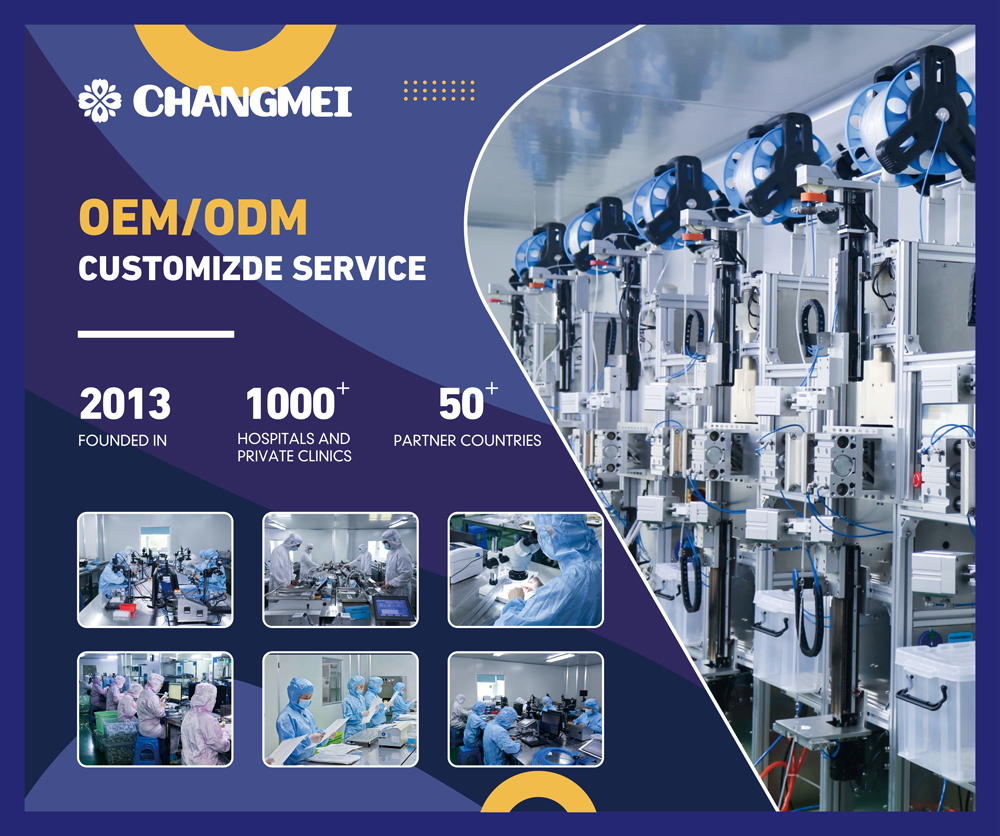
Jiangsu Changmei Medtech Co., Ltd. was founded in 2013 and operates from Changzhou, Jiangsu, in a 51,985 m² facility with 235 employees, including a 40-engineer R&D team. Stated annual output is 1,000,000 kyphoplasty balloon catheters, with exports to the EU, USA, Asia, South America and the Middle East at roughly 30% of output.
The distinguishing evidence is vertical integration. The supplier states that balloon tubing is extruded on three in-house lines and that balloon forming, necking, welding, four-wing folding and leak testing run on self-developed equipment, alongside ISO Class 7 cleanroom assembly and 100% per-piece pressure testing at ≥400 PSI. It further states that the balloon body is not subcontracted.
That statement is the pivot of the evaluation. If the balloon body is bought in, your audit stops at receiving inspection and the processes that most affect burst performance and pleat consistency sit outside your control. If it is made in-house, an audit can follow a lot from tube extrusion through to EO release.
Two claims should be carried with attribution rather than accepted as fact. The company reports approximately 80% share of the Chinese kyphoplasty balloon catheter market, and reports supplying as a qualified vendor to member companies of Medtronic and Stryker. Both are supplier-reported, not independently audited, and neither substitutes for an audit or for third-party proof in a tender. The company's own announcement also describes it as the first Chinese manufacturer to obtain EU MDR certification for kyphoplasty system products; that, too, is a company statement.
Factory audit shortlist: extrusion line records, balloon forming set-up sheets, folding equipment qualification, burst and leak bench calibration, cleanroom classification certificates, EO chamber records, a sample device history record, and the training matrix for folding operators.
Matching the Configuration to the Buying Channel
- Importer or distributor. Needs portfolio breadth across shaft platforms, registration support (technical file, IFU, UDI, free-sale certificate), a private-label option and marketing materials. A 10-set MOQ lets a first order test two or three SKUs before committing.
- Hospital group or GPO. Tender-stage documentation, lot traceability, pre-shipment test evidence, stated remaining shelf life and a change-notification clause carry more weight than catalogue breadth.
- Ambulatory surgery center. Compact single-use configurations, replenishment cadence and low minimum quantities matter more than a deep model range.
- Pain management and interventional clinics. KB0115 and KB0210S1 list these settings among their intended uses, which supports a narrow, procedure-specific stock rather than a full tray.
- OEM/ODM partner. Customization covers balloon diameter and length, cannula size and length, handle color and logo, packaging design, and labeling and language, with roughly 30 working days after specification confirmation.
Limits of This Framework
- A certificate proves scope, not lot performance; only the device history record closes that gap.
- 510(k) K223709 rests on bench data. Nothing in this framework establishes clinical superiority over another device.
- Market-share and supplier-audit claims are supplier-reported and should be labelled as such in tender documentation.
- Certificate status changes. The dates here reflect the documents supplied at evaluation and must be re-checked at order.
- A single audit is a snapshot of a quality system, not a forecast of future lots.
- Price competitiveness, reimbursement and clinician preference sit outside the ladder and need separate analysis.
Frequently Asked Questions
Which regulatory clearances should I verify for the balloon catheter, tool kit and inflator separately?
Each product group sits under a different document. The balloon catheter is covered by US 510(k) K223709 — Class II, Product Code HRX, 21 CFR 888.1100, bench data only — and by EU MDR quality-system certificate G10 088875 0012 Rev. 01 for Class IIa and Class IIb, valid to 20 March 2029. The KT-00-05 tool kit falls under that same MDR certificate and appears in FDA establishment registration and device listing 3016789487, alongside the BI-20A-10 inflator, which holds Class I sterile certification under G21 088875 0011 Rev. 00. EN ISO 13485:2016 certificate Q5 088875 0008 Rev. 05 covers the quality system and expires on 7 January 2027.
Can an OEM kyphoplasty system manufacturer support private-label distribution?
Yes, when OEM and ODM are production services rather than trading arrangements. CHANGMEI provides OEM private label, ODM custom design and authorized regional distribution, with technical documents, regulatory assistance and marketing materials included in the support scope. Customization covers balloon diameter and length, cannula size and length, handle color and logo, packaging design, and product labeling and language. MOQ for standard in-stock products is 10 sets; OEM/ODM quantities are negotiable against the specific requirement, and customized orders run about 30 working days after specification confirmation.
How can I confirm the supplier is a real factory that can scale?
Ask for process evidence rather than a company profile. Jiangsu Changmei Medtech was founded in 2013, occupies 51,985 m² in Changzhou with 235 employees, and states annual output of 1,000,000 kyphoplasty balloon catheters. The supplier states that tubing extrusion, balloon forming, necking, welding, four-wing folding, leak testing and cleanroom assembly are in-house, with 100% per-piece pressure testing at ≥400 PSI and no subcontracting of the balloon body. Verify that statement on site through extrusion records, folding equipment qualification and burst-bench calibration.
Is the balloon catheter single-use, and what sterilization documentation should accompany it?
The balloon catheter is a single-use sterile device; reuse and re-sterilization are prohibited, sterilization is by ethylene oxide (EO), and shelf life is three years. Use the device immediately once the package is opened and follow the official instructions for use. Request EO validation consistent with ISO 11135, residuals data, packaging validation, shelf-life justification, the lot release record and label artwork showing UDI and expiry format for your market.
What purchasing terms and acceptance criteria apply?
Stated terms are MOQ 10 sets for standard in-stock products, with OEM/ODM quantities negotiable; delivery EXW, FOB or CIF; acceptance by pre-shipment test; and full T/T payment before shipping. Because payment precedes shipment, convert the pre-shipment test into a contractual release gate by agreeing the report format, sampling plan and label check in writing, and by setting a minimum remaining shelf life in months at delivery.
What lead time applies to stock versus custom orders, and how does a sample evaluation start?
General lead time is stated as 30–45 days. In-stock models are separately stated to ship in about seven days ex-works, while custom OEM/ODM orders run about 30 working days after specification confirmation, so the purchase order should name the situation that applies. A practical start is a sample set drawn from the stock models you intend to tender — for example KB0115 and KB0210S1 to compare 6 cc and 3 cc inflation volumes — reviewed against the drawing revision and lot record before any volume commitment.
Conclusion
Capability is not a brochure property. For a kyphoplasty programme it is the sum of a controlled specification, a certificate whose scope names each SKU group, a lot record showing that burst and leak testing was run on your units, and a purchase order that fixes acceptance and lead time before the first carton ships. Model by model, the KB-Series answers the first three: KB0115 and KB0120 at 6 cc and ≥400 PSI, KB0210S1 at 3 cc with a 10 mm marker span, KT-00-05 in 06Cr19Ni10 stainless steel under CE 0123 coverage, and the BI-20A-10 inflator certified separately. What remains is the buyer's own work — auditing the folding line, fixing the acceptance clause, and tracking the certificate dates that expire between orders.
Next step. The KB-Series product catalogue, covering 8G and 11G kyphoplasty balloon catheters, tool kits and the balloon inflator, is available for download here: Kyphoplasty System Products (8G & 11G) — CE and FDA. Use it alongside the drawing revision and certificate pack when building your verification worksheet.
Have Questions or Need More Details?
Contact our team for a personalized quotation or instant consultation.
Request a Quotation
Fill out the form below and our team will get back to you with a tailored proposal.
WhatsApp Direct Chat
Prefer to chat in real-time? Message us on WhatsApp for instant assistance & quick answers.
- Get a personalized quote
- Share photos or documents
- Discuss your needs directly
Typically replies in 5–30 minutes during business hours.