
Kyphoplasty Application Guide: Matching Balloon Catheter Models to Spine, Orthopedic, and Pain Clinics
Balloon kyphoplasty model selection is decided by the care setting before it is decided by the catalogue. Within the CHANGMEI Kyphoplasty range, KB0115 is the 8G catheter with a 6 cc maximum inflation volume and a 15 mm radiopaque marker span, specified for use in orthopedic surgery, spine surgery, pain management and interventional pain clinics; KB0120 is the 8G, 6 cc, ≥400 PSI catheter specified for the same orthopedic, spine and pain settings; and KB0210S1 is the 11G, 280 mm model specified for spine surgery, pain management and interventional pain clinics.
This guide is written for clinical and procurement teams at the evaluation-to-execution stage — the point at which a shortlist has to become a stocked SKU mix. It maps each model to the settings it is specified for, explains the six specification fields that decide fit (marker distance, maximum inflation volume, constrained burst pressure, overall length, channel ID and gauge), and closes with the accessory and documentation points that procurement usually discovers too late.
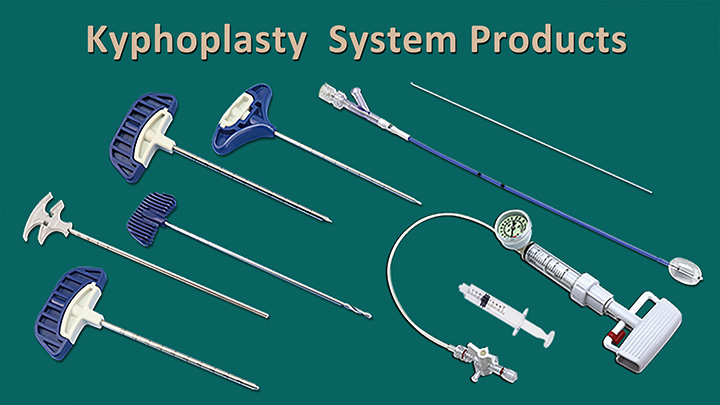
CHANGMEI Kyphoplasty balloon catheter platform, used across spine, orthopedic and interventional pain settings.
The Selection Problem: One Procedure, Three Different Rooms
Percutaneous balloon kyphoplasty (PKP) is a single procedure. A working cannula is advanced into the fractured vertebral body, an inflatable bone tamp is expanded to create a contained cavity and partially restore height, the balloon is deflated and removed, and low-viscosity PMMA bone cement is delivered into the cavity under low pressure. What changes between buyers is not the procedure — it is the room it is performed in.
Three settings dominate demand for kyphoplasty balloon catheters:
- Interventional pain clinics and pain management practices. Single C-arm, compact tray, high procedure turnover, same-day discharge. These buyers want one gauge, one balloon diameter band and predictable single-use stock.
- Hospital spine surgery programmes. Biplane or motorised C-arm imaging, standardised trays, a case mix that includes upper-thoracic levels and osteoporotic vertebrae. These buyers usually need both the 8G and 11G working channels on the shelf at the same time.
- Orthopedic departments. Vertebral compression fractures from osteoporosis, low-energy trauma and neoplastic involvement, often handled alongside a broader trauma or spinal list. These buyers tend to favour the wider 8G lumen for straightforward transpedicular access.
Each of these settings constrains the catheter in a different way, which is why a single-catalogue approach produces either unused inventory or an avoidable stockout. Six specification fields decide whether a model actually fits a given setting:
- Marker distance. The distance between the two radiopaque markers sets how the balloon is read against the endplates on fluoroscopy. On KB0115 that marker-to-marker distance is 15 mm.
- Maximum inflation volume. The volume ceiling determines the cavity the operator can create and, indirectly, the cement volume budgeted per level.
- Constrained burst pressure. The pressure the balloon must survive while constrained inside cancellous bone. The KB platform is specified at ≥400 PSI.
- Overall length. 315 mm on the 8G platform and 280 mm on the 11G platform — this affects reach and clearance against the imaging setup.
- Channel ID and gauge. The gauge determines which working cannula, trocar and instrument tray the catheter passes through. 8G runs an ID of ≥3.65 mm; 11G runs ≥3.10 mm.
- Accessory compatibility. Whether the catheter is used with a dedicated tool kit and balloon inflator, or dropped into an existing tray.
The procurement consequence is direct. A model that is clinically correct but incompatible with the tray already in the department generates a second purchase order, a second training cycle and a second line in the storeroom. A model that is compatible but sized for the wrong cavity volume either under-fills the level or leaves cement unused on the back table.
Industry Background: Site of Service Is Reshaping Catheter Demand
Two forces are moving kyphoplasty demand toward setting-specific purchasing: procedure volume growth and the economics of where the procedure is performed.
The global kyphoplasty market was valued at USD 764.13 million in 2025 and is projected to reach USD 1,342.29 million by 2034, according to one market research estimate. North America held an estimated 42.5% to 50.0% revenue share in 2025. Published market-size figures vary between research houses because some bundle bone cement and vertebroplasty into the same definition and others count kyphoplasty devices only — a reminder to compare definitions, not just headline numbers, before quoting any of them internally.
Site of service matters because reimbursement differs by site. The 2025 Medicare ambulatory surgical centre final rate for kyphoplasty (CPT 22513 and 22514) was set at approximately USD 3,510.84, a 3.5% increase over 2024, based on CMS final rates as summarised by the American Society of Interventional Pain Physicians. For a clinic or an ASC, that economics rewards a compact, single-gauge tray and fast turnover — which pushes demand toward catheters that are simple to stock and simple to teach.
On the regulatory side, the European market has become harder to enter. Kyphoplasty balloon catheters sit under Regulation (EU) 2017/745 (MDR), and the quality-system and technical documentation burden now separates manufacturers that hold current MDR certification from those still working through transition. Jiangsu Changmei Medtech states that it was the first Chinese company to receive EU MDR CE certification for kyphoplasty system products — a claim relevant to buyers because the same certificate file covers the catheters and the tool kits they will actually order.
Jiangsu Changmei Medtech Co., Ltd. (CHANGMEI) is a medical device manufacturer founded in 2013 and headquartered in Changzhou, Jiangsu, China, producing kyphoplasty balloon catheters, kyphoplasty tool kits and balloon inflators. The company operates a 51,985 m² facility with 235 employees, including a 40-engineer R&D team, and reports annual output of 1,000,000 units of kyphoplasty balloon catheter with exports representing 30% of sales across the EU, USA, Asia, South America and the Middle East.
The CHANGMEI KB Platform: What Is Shared Across All Models
Before comparing models, it helps to separate platform-level specifications from model-level ones. These properties apply across the KB range and do not change with your choice of model:
- Medical-grade thermoplastic polyurethane (TPU) balloon, mounted on a polyurethane shaft, with radiopaque markers and a stainless-steel stylet.
- Four-wing pleated balloon construction that expands to create a defined intracorporal cavity.
- Constrained burst pressure of ≥400 PSI across the 10 mm, 15 mm and 20 mm balloon diameters.
- Cylindrical and peanut balloon shapes available within the range.
- 100% pressure-seal testing per piece, with 100% testing as the stated quality-control regime.
- Single-use sterile devices, sterilised by ethylene oxide (EO), with a 3-year shelf life.
One clarification is worth carrying into any clinical conversation: ≥400 PSI is a constrained burst specification, not a working target. In the procedure itself, inflation is typically taken to roughly 50–300 PSI depending on vertebral body resistance. The burst figure describes the safety envelope the balloon is built and tested to, not the pressure an operator aims for.
Model-by-Model Fit: KB0115, KB0120 and KB0210S1
KB0115 — 8G, 6 cc, 15 mm marker span for pain clinics and orthopedic / spine settings
KB0115 is a kyphoplasty balloon catheter intended for use in orthopedic surgery, spine surgery, pain management and interventional pain clinics, and it belongs to the Balloon Kyphoplasty (PKP) Products category. Its specified construction is a medical-grade TPU balloon mounted on a PU shaft, with radiopaque markers and a stainless-steel stylet. The distance between the two radiopaque markers is 15 mm.
Two specifications make it the natural default for interventional pain clinics. First, the maximum inflation volume is 6 cc, which supports a full-size cavity without committing the clinic to a multi-volume inventory. Second, the 8G shaft — an ID of ≥3.65 mm and an overall length of 315 mm — gives a wider working lumen and easier balloon trackability for operators who perform a moderate volume of kyphoplasty alongside other interventional procedures rather than weekly spine lists.
KB0115 is a single-use sterile device, sterilised by ethylene oxide, with a 3-year shelf life. It must not be re-sterilised or reused, and should be used immediately once the package is opened. As an 8G catheter it is compatible with the Changmei KT-00-01 8G tool kit and the BI-20A-10 balloon inflator.
KB0120 — 8G, 6 cc, ≥400 PSI for spine surgery programmes
KB0120 is a Balloon Kyphoplasty (PKP) product intended for use in orthopedic surgery, spine surgery, pain management and interventional pain clinics. It is supplied in 8G, made of medical-grade TPU, and specified with a maximum inflation volume of 6 cc and a constrained burst pressure of ≥400 PSI.
Where KB0115 and KB0120 overlap — both are 8G, both carry a 6 cc volume ceiling — the practical difference for a spine programme is tray architecture rather than performance class. KB0120 is the model to specify when the department has standardised on a classic 8G working channel tray and wants the pressure specification stated explicitly on the purchase documentation. Hospitals that transfer cases between an orthopedic list and a spine list can run a single 8G catheter SKU across both, provided the accessory tray is the same.
KB0210S1 — 11G platform for spine surgery, pain management and interventional pain clinics
KB0210S1 is intended for use in spine surgery, pain management and interventional pain clinics, and belongs to the Balloon Kyphoplasty (PKP) Products category. It sits on the 11G platform: an ID of ≥3.10 mm and an overall length of 280 mm, with a cross-section approximately 47% smaller than the 8G cannula.
That smaller footprint is the reason this model exists in the range. It reduces the pedicle footprint and paraspinal trauma, and makes upper-thoracic access easier — the two reasons a spine programme adopts an 11G tray in the first place. Cavity volume on the 11G platform is 3 cc with a 10 mm balloon, 4 cc with a 15 mm balloon and 6 cc with a 20 mm balloon, so the model selected still has to be matched to the balloon diameter the surgeon intends to use, not just to the gauge.
The practical rule for a mixed portfolio: 8G models carry the wider lumen and the easier tracking curve, 11G models carry the smaller access profile. A department that treats upper-thoracic levels or markets a minimally invasive PKP pathway will need the 11G line; a clinic that treats mainly lumbar levels through a familiar tray will not.
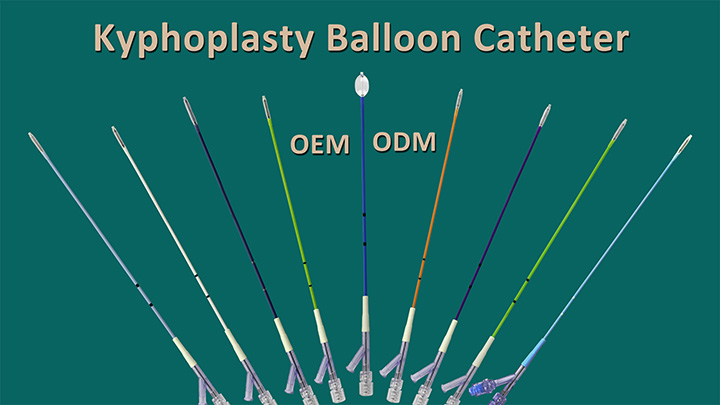
8G and 11G KB-series catheters share the same TPU balloon construction, four-wing pleating and ≥400 PSI constrained burst specification.
Step-by-Step: Selecting a Model for a Specific Clinic or Department
The sequence below is designed to be run once per care setting, not once per order. It converts a clinical description into a specification and then into a purchase line.
- Fix the working channel first. Confirm whether the department's trays are 8G or 11G. This single answer eliminates half the catalogue. 8G covers KB0210, KB0115 and KB0120; 11G covers KB0210S1, KB0115S1 and KB0120S1.
- Set the balloon diameter band. Balloon diameters available across the range are 10 mm, 15 mm and 20 mm, in cylindrical and peanut shapes. The band selected determines the cavity volume: on the 8G platform, 4 cc at 10 mm or 15 mm and 6 cc at 20 mm; on the 11G platform, 3 cc at 10 mm, 4 cc at 15 mm and 6 cc at 20 mm.
- Check the maximum inflation volume against the cement budget. KB0115 and KB0120 are both specified at 6 cc. If the department's cement protocol assumes a fixed cavity volume per level, confirm the balloon diameter that produces it.
- Confirm marker distance and the fluoroscopy protocol. KB0115 carries a 15 mm marker-to-marker distance. Whatever model is chosen, the imaging team should confirm the marker span against the endplate landmarks they use for positioning.
- Check overall length against the room. 315 mm on the 8G models and 280 mm on the 11G models. Length affects reach and how the catheter sits against the C-arm and table during a lateral projection.
- Confirm the pressure specification is documented. The KB platform is specified at ≥400 PSI constrained burst pressure, with 100% pressure-seal testing per piece. Ask for the specification on the technical file, not just the datasheet.
- Match the accessory set. Decide whether the department uses the Changmei KT-00-01 8G tool kit or the KT-00-05 tool kit, and whether the BI-20A-10 balloon inflator is being supplied with the catheters or sourced separately.
- Verify the documentation pack for the destination market. CE MDR certification for the EU, FDA 510(k) K223709 for the US, ISO 13485:2016 for the quality system, and the IFU in the required language.
- Decide the stock split. For a distributor with no prior gauge-split data, the practical starting point is to make 8G the base stock and add 11G only where a named account has adopted an 11G tray or an upper-thoracic case mix.
Use Cases by Care Setting
Interventional pain clinic, outpatient
A single-room pain practice running a modest monthly kyphoplasty volume needs one gauge, one volume, minimal shelf space and no re-sterilisation workflow. KB0115 fits this profile: 8G, 6 cc, 15 mm marker span, single-use EO-sterilised with a 3-year shelf life, and specified for pain management and interventional pain clinic use. Because the clinic teaches one catheter, the training load stays inside a single in-service session.
Hospital spine surgery programme
A spine unit handling osteoporotic and neoplastic compression fractures typically runs two working channels in parallel. KB0120 covers the standard 8G transpedicular approach at 6 cc and ≥400 PSI. KB0210S1 covers the 11G pathway for upper-thoracic access and reduced paraspinal trauma. Running both from one manufacturer matters operationally: it means one quality-system file, one sterility validation and one traceability chain instead of two.
Orthopedic department with a mixed trauma list
Orthopedic buyers generally want the wider lumen and the more forgiving tracking curve that the 8G platform provides, particularly where the operating surgeon performs kyphoplasty periodically rather than weekly. Both KB0115 and KB0120 are specified for orthopedic surgery, so the choice between them falls back to tray standardisation and to whether the pressure specification needs to appear explicitly on the tender documents.
Distributor building a first portfolio
For a distributor, the selection question is portfolio shape rather than a single SKU. The 8G models — KB0210, KB0115 and KB0120 — form the base layer because they fit classic PKP trays and are the default in many Latin American, Middle East and CIS markets. The 11G models — KB0210S1, KB0115S1 and KB0120S1 — are added where accounts are moving toward a less invasive PKP positioning or competing directly against 11G kits from larger brands. Because both gauge families run on the same folding line, the same ≥400 PSI test bench and the same ISO 13485:2016 quality system, the distributor is managing two SKUs from one audited source rather than two suppliers' risk profiles.
Comparison Table: KB0115 vs KB0120 vs KB0210S1
| Parameter | KB0115 | KB0120 | KB0210S1 |
|---|---|---|---|
| Gauge / channel ID | 8G, ID ≥3.65 mm | 8G, ID ≥3.65 mm | 11G, ID ≥3.10 mm |
| Overall length | 315 mm | 315 mm | 280 mm |
| Maximum inflation volume | 6 cc | 6 cc | 3 cc (10 mm) / 4 cc (15 mm) / 6 cc (20 mm) |
| Constrained burst pressure | ≥400 PSI | ≥400 PSI | ≥400 PSI |
| Marker-to-marker distance | 15 mm | See IFU / technical file | See IFU / technical file |
| Balloon material / construction | Medical-grade TPU on PU shaft, radiopaque markers, stainless-steel stylet | Medical-grade TPU | TPU platform, four-wing pleating |
| Specified care settings | Orthopedic surgery, spine surgery, pain management, interventional pain clinics | Orthopedic surgery, spine surgery, pain management, interventional pain clinics | Spine surgery, pain management, interventional pain clinics |
| Sterilisation / shelf life | Single-use, EO sterilised, 3-year shelf life | Single-use, EO sterilised | Single-use, EO sterilised |
| Compatible accessory set | KT-00-01 8G tool kit, BI-20A-10 balloon inflator | 8G tool kit range | KT-00-05 tool kit, BI-20A-10 balloon inflator |
| Regulatory coverage | FDA 510(k) K223709; EU MDR CE | FDA 510(k) K223709; EU MDR CE | FDA 510(k) K223709; EU MDR CE |
Specifications as stated in Changmei product and technical documentation for the KB-series. Marker spacing for models other than KB0115 should be confirmed against the IFU and technical file at quotation.
Supporting Tools: the KT-00-05 Tool Kit and the Balloon Inflator
Catheter selection is only half of a workable tray. The KB-series is supported by two accessory families that procurement teams should scope in the same order rather than afterwards.
Kyphoplasty tool kits. KT-00-01 is the 8G tool kit that pairs with the 8G catheters. KT-00-05 is the second tool kit in the range and is listed as an applicable product under both the EU MDR quality-system certificate G100888750012 Rev. 01 issued by TÜV SÜD Product Service GmbH and the FDA establishment registration 3016789487, which covers the Kyphoplasty Tool Kit and the Balloon Inflator. For a buyer, that means the accessory is inside the same certification envelope as the catheter — one audit trail, not two.
BI-20A-10 balloon inflator. The inflator is the pressure-controlled delivery component: a hand-held device with an integrated gauge, connected to the balloon catheter through contrast-filled tubing, allowing inflation to a preset pressure limit. It is listed under FDA establishment registration 3016789487 and under the EU MDR Class I sterile quality assurance certificate G21 088875 0011 Rev. 00. Because the balloon is specified at ≥400 PSI constrained burst while normal working inflation sits far lower, the gauge is the instrument that keeps the operator inside the intended envelope.
Compliance and Documentation Checkpoints
Model selection should be finalised only after the documentation pack has been checked against the destination market. The relevant Changmei records are:
- EU MDR quality management system certificate G100888750012 Rev. 01, issued by TÜV SÜD Product Service GmbH, covering Class IIa and Class IIb devices under Regulation (EU) 2017/745 Annex IX Chapters I and III, issued 2026-06-18 and valid to 2029-03-20.
- EU quality assurance certificate (MDR) G21 088875 0011 Rev. 00, covering Class I sterile devices under Annex XI Part A, issued 2024-03-21 and valid to 2029-03-20 — the certificate under which the Balloon Inflator is listed.
- ISO 13485:2016 certificate Q5 088875 0008 Rev. 05, issued by TÜV SÜD Product Service GmbH, covering design, development, production and distribution of disposable sterile medical devices, valid to 2027-01-07.
- FDA 510(k) premarket notification K223709, covering KB0210, KB0115, KB0120, KB0210S1, KB0115S1 and KB0120S1.
- FDA establishment registration and device listing 3016789487, covering the Balloon Inflator and Kyphoplasty Tool Kit.
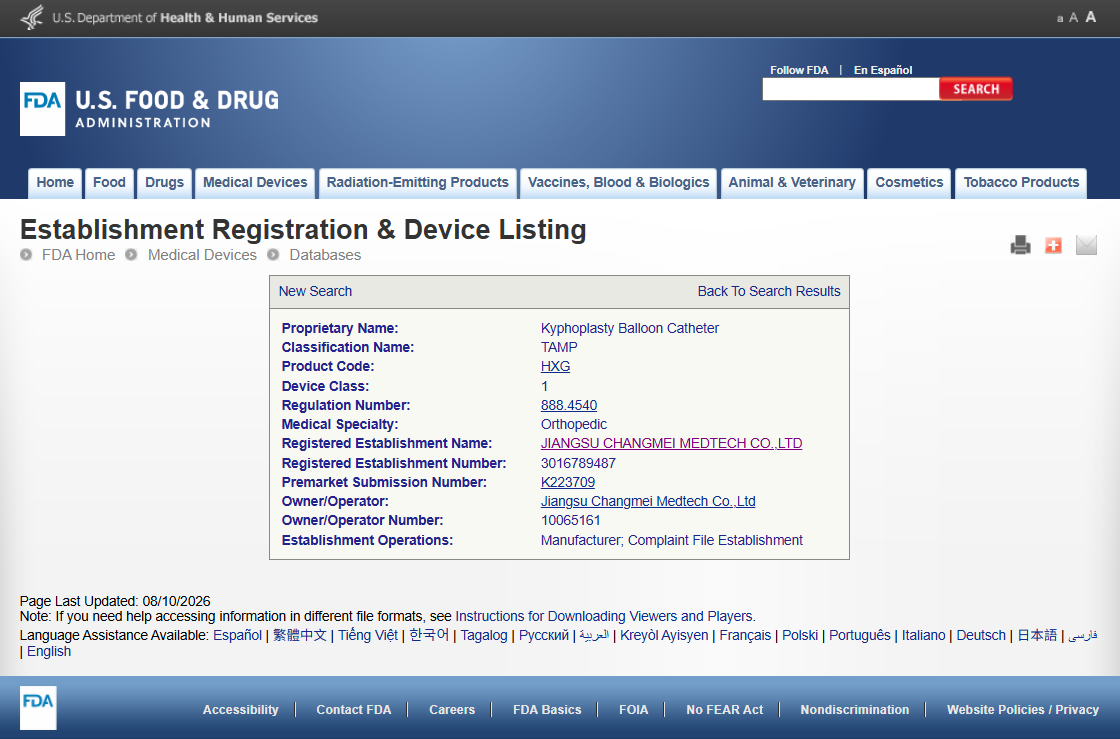
FDA 510(k) K223709 covers the KB-series kyphoplasty balloon catheter models discussed in this guide.
Two clinical constraints belong in the same checklist. First, every balloon catheter in the range is single-use and must not be re-sterilised or reused; the package should be opened immediately before use. Second, model selection does not override patient selection. The device is not applicable for patients with a damaged vertebral posterior edge, nerve injury, infection at the operative site or uncorrectable coagulopathy, and the full contraindication list in the IFU governs clinical use.
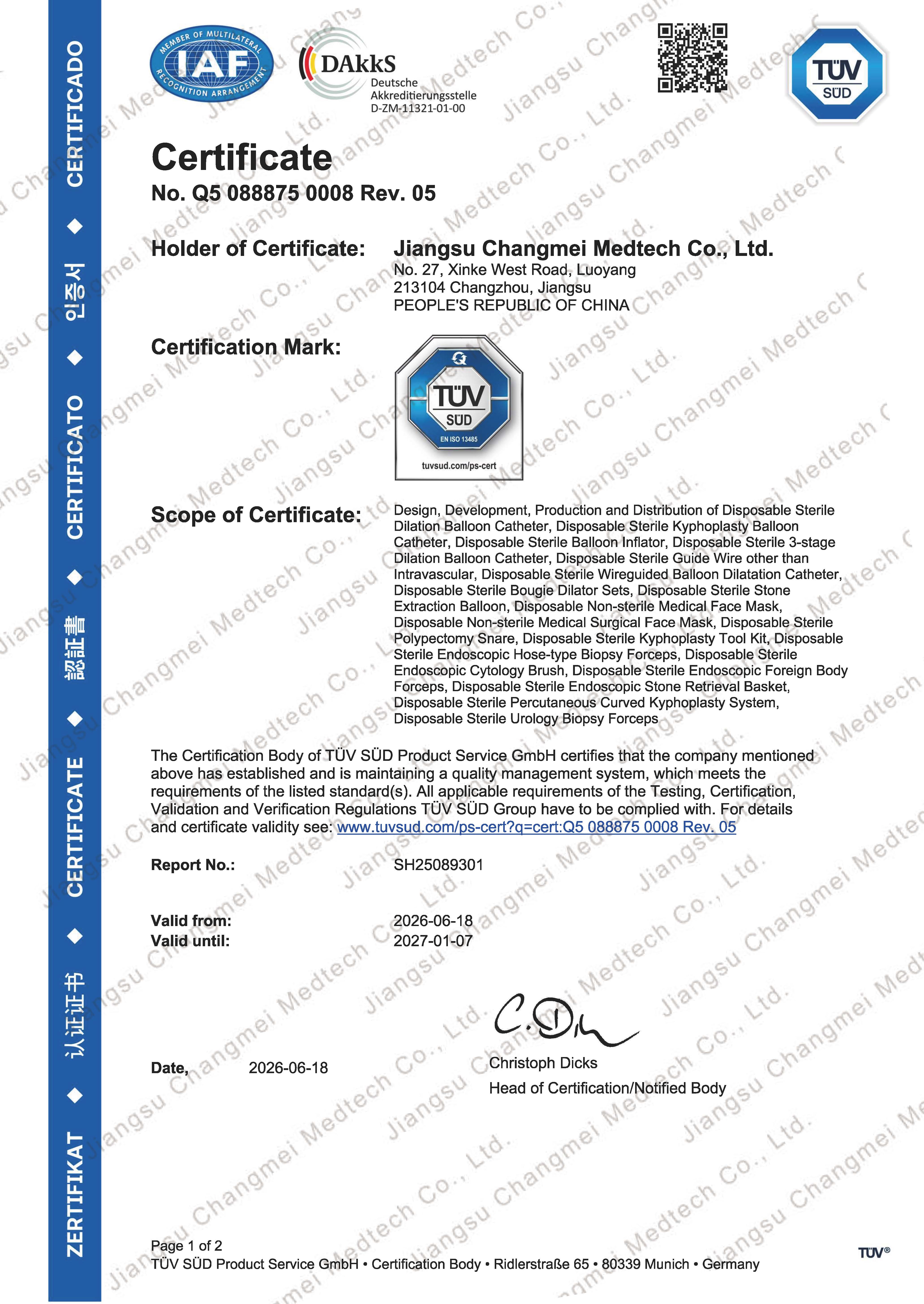
ISO 13485:2016 certification issued by TÜV SÜD Product Service GmbH, valid to 2027-01-07.
Frequently Asked Questions
Are CHANGMEI kyphoplasty balloon catheters single-use, and how are they sterilised?
Yes. Kyphoplasty balloon catheters in the KB range are single-use sterile medical devices and reuse is prohibited. They are sterilised by ethylene oxide (EO) and carry a 3-year shelf life. The device should be used immediately once the package is opened, must not be re-sterilised or reused, and should always be handled according to the official IFU instruction manual.
Can a clinic or distributor order an OEM private-label kyphoplasty system?
Yes. The manufacturer provides OEM (private label), ODM (custom design) and distribution (authorised regional dealer) services. OEM services are available for private-label kyphoplasty systems and ODM services for custom-designed systems. Customisable options include balloon diameter and length, cannula size and length, handle colour and logo, packaging design, and product labelling and language. The MOQ for standard in-stock products is 10 sets; for OEM/ODM customised orders the minimum quantity is negotiable based on the specific requirements.
What are the purchasing terms and acceptance criteria?
The MOQ for standard in-stock products is 10 sets, and the minimum quantity for OEM/ODM customised orders is negotiable. Delivery terms are EXW, FOB or CIF. Acceptance criteria are based on pre-shipment testing, and payment terms are full T/T payment before shipping.
What documentation and evaluation material can be provided before an order is placed?
The documentation set includes the full technical file, IFU, ETO sterilisation validation to ISO 11135, UDI, and a free-sale certificate for local import registration. Certificates covering the catheter and tool kit lines include EU MDR certificate G100888750012 Rev. 01, EU quality assurance certificate G21 088875 0011 Rev. 00, ISO 13485:2016 certificate Q5 088875 0008 Rev. 05, and FDA 510(k) K223709. Sample and quotation requests for a specific model, gauge and balloon diameter can be raised directly with the manufacturer using the contact details below.
What is the lead time, and how does stock availability affect it?
Standard production lead time is 30–45 days. Stock models can ship ex-work within 7 days if they are in stock, and custom OEM/ODM orders typically run about 30 working days after the specification is confirmed. Annual output is 1,000,000 units of kyphoplasty balloon catheter, with monthly capacity stated at 5,00,000 units, and every piece is pressure-seal tested before shipment.
Conclusion: Match the Model to the Room, Then to the Purchase Order
Model selection in kyphoplasty works in one direction: setting first, specification second, SKU third. Interventional pain clinics and pain management practices get the simplest inventory from KB0115 — 8G, 6 cc, 15 mm marker span, single-use and EO sterilised. Spine surgery programmes that have standardised on a classic tray specify KB0120 at the same 8G, 6 cc and ≥400 PSI, while programmes moving toward a smaller access profile add KB0210S1 on the 11G, 280 mm platform. Orthopedic departments are covered by the 8G models their trays already accept.
Everything else — the tool kit, the inflator, the certificate file, the MOQ and the lead time — should be confirmed in the same evaluation cycle, because a catheter that arrives without a compatible tray and a valid certificate is not a stocked item.
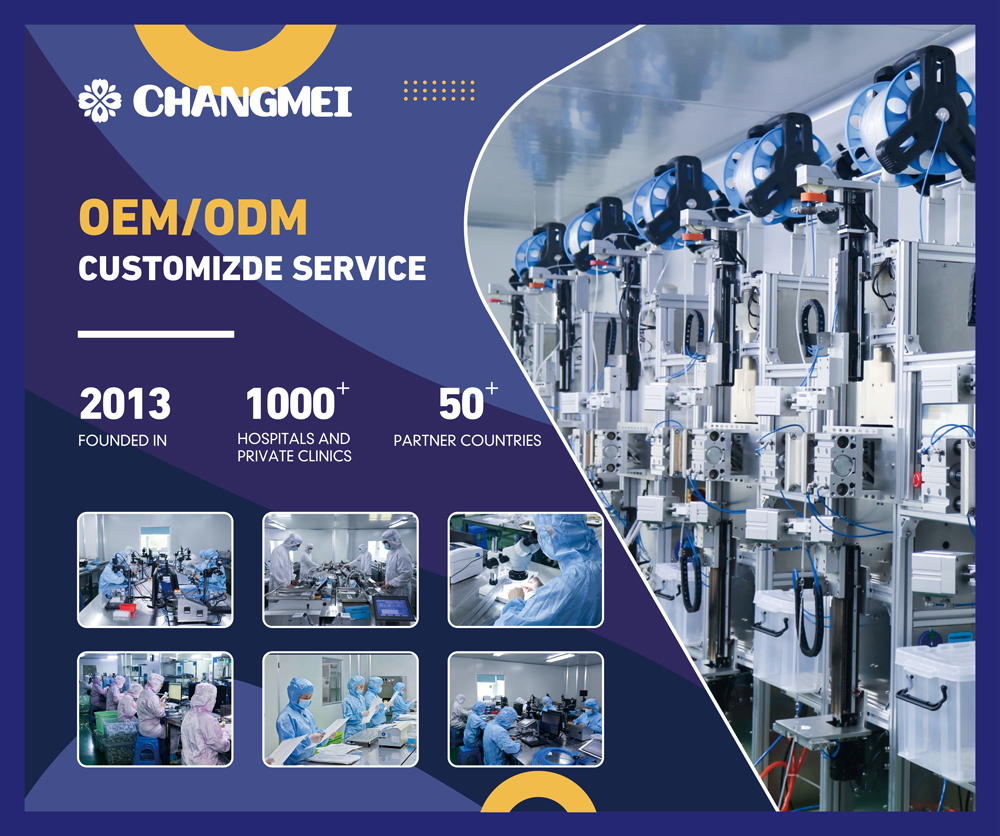
KB-series kyphoplasty balloon catheters, tool kits and balloon inflators are available for OEM, ODM and authorised distribution.
Next step: confirm the model against your setting
Send the gauge in use, the balloon diameter band and the intended care setting, and CHANGMEI will confirm the matching KB-series model, the compatible tool kit and inflator, and the applicable certificate file for your market. Sample and quotation requests are handled directly.
Website: www.czmed.com
Email: cyz@czmed.com | Tel / WhatsApp: +86 138-1368-7682
Address: No.27 Xinke West Road, Luoyang Town, Wujin District, Changzhou City, Jiangsu Province, China
Download the Kyphoplasty System Catalogue (8G & 11G, CE and FDA)
Have Questions or Need More Details?
Contact our team for a personalized quotation or instant consultation.
Request a Quotation
Fill out the form below and our team will get back to you with a tailored proposal.
WhatsApp Direct Chat
Prefer to chat in real-time? Message us on WhatsApp for instant assistance & quick answers.
- Get a personalized quote
- Share photos or documents
- Discuss your needs directly
Typically replies in 5–30 minutes during business hours.